
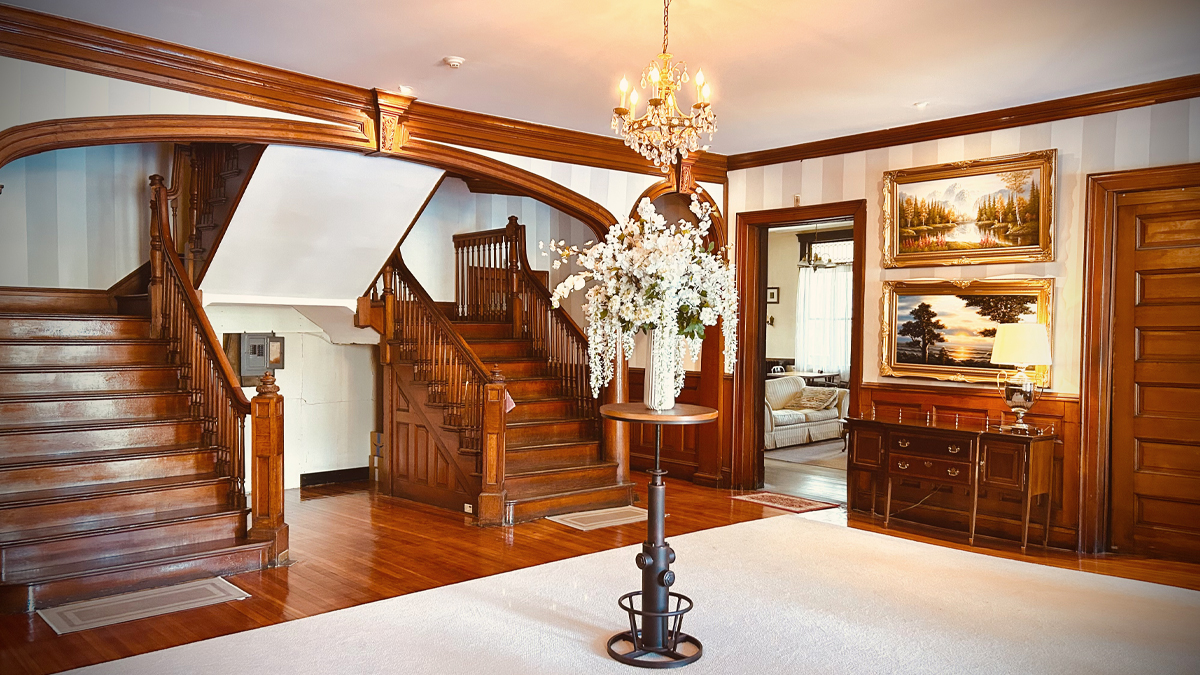
Maintaining A 120 Year Old Historic Landmark

Stewardship, Preservation, and the Work of Time

As the owner and operator of Idylease in West Milford, New Jersey, I understand that I am only a temporary steward of this historic landmark. I am fourth in a line of owner-operators who have made the preservation of this structure part of their life’s work. That responsibility is never far from my daily activity.

Preservation is not simply about saving old buildings. At its best, it allows the past to remain in conversation with the present. Architecture is one of the clearest expressions of history and place. A building holds evidence of the people who lived, worked, recovered, waited, and passed through its rooms.

By preserving historic structures, we preserve more than wood, stone, plaster, and glass. We preserve the spaces where earlier generations lived their lives. These places allow us to encounter the aesthetic, cultural, and human history of another era in a way that cannot be recreated once it is lost.

There is no opportunity to save a historic site after it is gone. And we can never know with certainty what future generations will come to value.

Jacqueline Kennedy Onassis once said, “If we don’t care about our past, we cannot hope for the future. … I desperately care about saving old buildings.” Her words remain true. Preservation is not nostalgia. It is an act of care directed toward the future.

Every day, I think about my father, Dr. Arthur Zampella, and about Dr. Edgar Day and Dr. Daniel Drake, who came before me at Idylease. I also think about the many people who have passed through its doors since New Year’s Day in 1903.

When my hand runs along the stairway banister, I know other hands have touched the same wood. Patients, doctors, nurses, guests, workers, families, and visitors all left some part of themselves here.

That is where preservation begins for me.

Not with ownership.

With contact.

I am honored to play a small role in the continuing preservation of Idylease, and in carrying this historic landmark forward for future generations.

—Richard Zampella

Continue Reading

Noted Guest Timeline at Idylease in the 20th Century.


THOMAS EDISON

Thomas Edison’s most noteworthy contribution to the Franklin-Ogdensburg mining district was to serve as a innovator in mining and milling methods, including new techniques in blasting, conveying, crushing, and magnetic separation. His renowned electrical and telephone systems were employed in Franklin and Ogdensburg at an early time.

F. Fichter Hoagan, the facilities manager at Idyleaase for Dr. Daniel Drake often reminisced of the days when Edison would spend the evening at Idylease while working on a magnetic ore extracting device at the Franklin/Ogdensberg Mine. Newfoundland served as the half-way point between Edison’s lab in West Orange, NJ and he would stop to have his car serviced at a garage in Newfoundland. He would spend the night at Idylease before proceeding on to the Franklin mines. Edison was no stranger to Newfoundland. He had filmed scenes from “The Great Train Robbery” in Echo Lake.

CONGRESSWOMAN MARY T. NORTON

Mary Teresa Norton (March 7, 1875 – August 2, 1959) was an American politician. The sixth woman in the United States Congress, she was the first from an Eastern state (New Jersey), and the first non-Republican (she was a Democrat). She went on to serve an unprecedented 13 consecutive terms in the United States House of Representatives, from 1925 to 1951, and chaired four committees. She was a labor advocate and a supporter of women’s rights. During the late 1920’s Ms.Norton was a regular guest at Idylease.

HORATIO COLLINS KING

American Civil War Medal of Honor Recipient: Guest at Idylease in 1913 – Horatio Collins King (December 22, 1837 – November 15, 1918) was a Union Army soldier who received the Medal of Honor for his actions during the American Civil War. He also served as a U.S. lawyer, politician and author and was admitted to the bar in New York City in 1861. He served in the armies of the Potomac and Shenandoah during the Civil War from August 1862 until May 1865, when he resigned with the rank of brevet colonel. King earned the Medal of Honor for service near Dinwiddie Courthouse, Virginia, on March 31, 1865. King was the son of the Postmaster General of the United States under President James Buchanan.

WILLIAM B. HANNA

Although familiar with virtually all games in the realm of sports, William B. Hanna (1862–1930) specialized in sports writing in baseball and football. He was brought up in Kansas City and began his newspaper career with the Kansas “Star” but came to New York in 1888, joining the staff of the New York, “Herald.” He is widely considered one of the most noted sports writers of the period.

His style was noted for his eschewing of slang such as “swat, pill, horsehide”, etc. His choice of words were those less chosen, terse, precise, kind. His style was succinct, his knowledge encyclopedic. He always signed his copy, William B. Hanna, and became upset if anyone changed it.

DAVID BANKS SICKELS

David Banks Sickels (1837-1918) was a Civil War Correspondent, Fiscal Agent for the State of Arkansas, a Diplomatic Representative of Siam and Acting Consul of The Netherlands. With Lyman W. Griggs he founded the American Surety Company and upon his retirement, focused on literary work. He authored a prolific amount of poems, many of which were published in “Leaves of the Lotos” and “Flowers from the Wayside”.


Continue Reading

Richard Zampella News 12 New Jersey Idylease Interview

https://www.facebook.com/idylease/videos/371705573508318/


Watch News 12 New Jersey Interview with Richard Zampella on Idylease in West Milford, NJ and its bid to be placed on the National Register of Historic Places with the Department of Interior in Washington, DC. Idylease, a turn-of-the-century health resort counted inventor Thomas Edison among its famous guests and is in the process of making its bid for the National Register.

Continue Reading